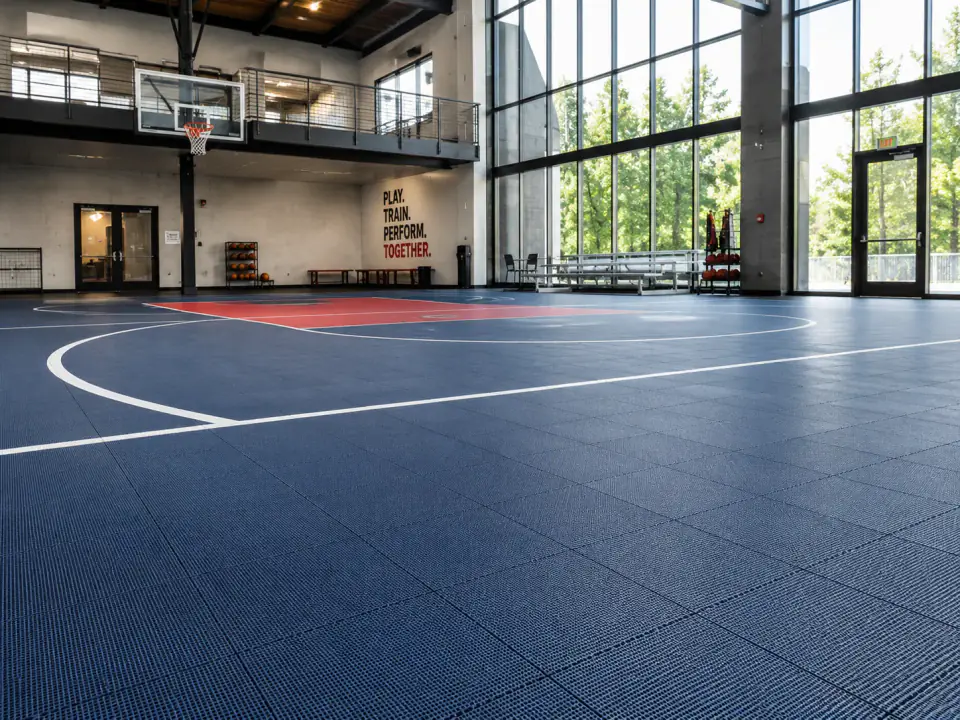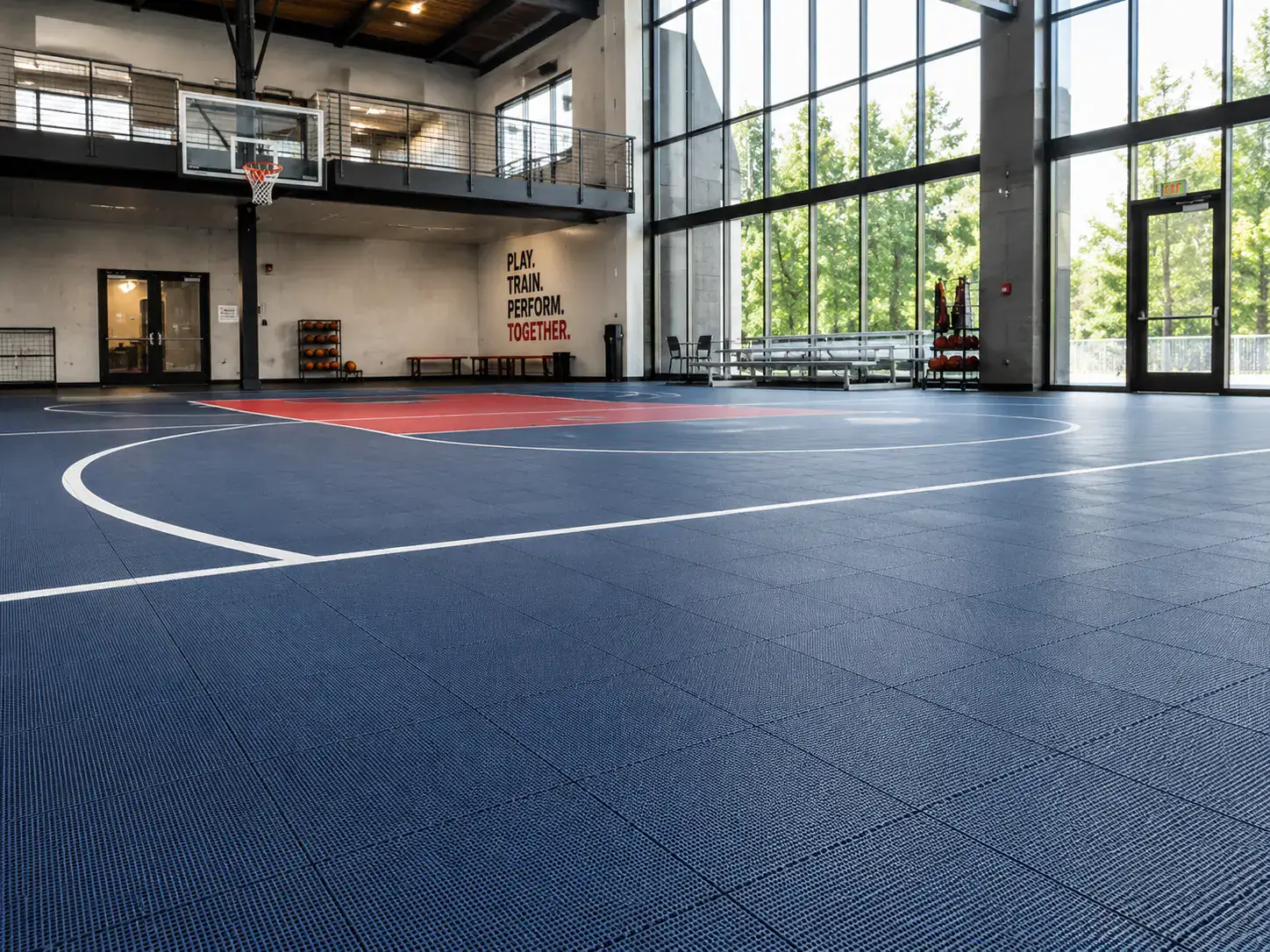
PE sports flooring uses tough polyethylene tiles that interlock to form a continuous playing surface, laid over a prepared base without adhesive. It is a practical choice for multi-use games areas, school courts, community sports halls and other high-traffic spaces because it is quick to install, easy to repair and can be marked out for several sports. This guide explains how interlocking sports floor tiles work, what the base underneath needs and how PE flooring compares with other sports hall flooring options.
What PE sports flooring is
PE stands for polyethylene, a widely used plastic that is tough, flexible and resistant to moisture and many chemicals. In sports flooring it is moulded into tiles with connectors on each edge, so they click together into a single surface.
Interlocking sports floor tiles are made from various polymers, and the exact formulation, surface texture and underside structure differ between products. Those differences affect grip, ball response, comfort underfoot and how the floor copes with temperature changes.
Our PE floors are durable, impact-resistant flooring designed for sports and high-traffic spaces, available in finishes GSPE-001, GSPE-002 and GSPE-003.
How interlocking sports floor tiles work
The tiles form a floating floor. They are not glued to the base; their own interlocks hold them together, and the weight and friction of the whole floor keep it in place. This brings several practical benefits:
- Speed. Tiles can be laid quickly by a small team once the base is ready.
- Repairs. A damaged tile can be unclipped and replaced without disturbing the rest.
- Flexibility. Colours can be mixed to create court zones, borders and logos.
- Relocation. In some cases the floor can be lifted and re-laid elsewhere.
Because the floor floats, it needs room to move. Polyethylene expands and contracts with temperature, so the installer leaves an expansion gap around the perimeter and at fixed objects such as posts and walls, following the product's guidance.
Indoor and outdoor use
Sports halls and indoor courts
Indoors, PE tiles are typically laid over a level concrete or screed slab. Some systems use an underlay to add comfort and reduce impact on joints. Line markings for basketball, netball, badminton, futsal and other sports can be applied to suit the hall's programme.
Multi-use games areas
For multi-use games area flooring outdoors, tiles are often perforated so rainwater passes straight through to a free-draining or falling base below. Outdoor tiles are exposed to UV light, frost and bigger temperature swings, so check the product is intended for outdoor use and follow the manufacturer's advice on expansion gaps and colour choice.
High-traffic spaces
Beyond sport, PE flooring suits play areas, school yards, event spaces and other areas where a tough, quickly installed surface is useful.
The base underneath matters most
A floating floor follows the surface below it. Dips, humps and soft spots in the base will show as uneven play, ball bounce that varies across the court and tiles that rock or separate.
Requirements for a good base usually include:
- A firm, stable surface such as concrete or bound asphalt.
- A level finish within the flatness tolerance the tile manufacturer specifies.
- A clean surface free of loose material, oil and standing water.
- Outdoors, falls or drainage so water does not pond under the tiles.
- Cured slabs, so moisture does not cause problems indoors.
If you are converting an existing tennis court or playground, have the base surveyed first. Cracks and depressions often need repairing before new tiles go down.
Comparing sports hall flooring options
PE interlocking tiles are one of several options for sports and multi-use spaces. Each has strengths depending on the sports, users and budget.
| Floor type | How it is installed | Strengths | Points to consider |
|---|---|---|---|
| PE interlocking tiles | Floating, clipped together over a prepared base | Quick install, individual tile repair, indoor or outdoor options | Needs a flat base and perimeter expansion gaps |
| Sprung timber floor | Timber boards on a sprung or battened subfloor | Traditional feel for indoor sports | Higher cost and sensitive to moisture |
| Poured polyurethane | Liquid resin poured and cured on site | Continuous surface, good for indoor halls | Longer installation and curing time |
| Artificial grass | Laid on a prepared, free-draining base | Suits football and outdoor MUGAs | Infill maintenance; not ideal for ball-bounce sports |
The right choice depends on which sports will be played most, the age and level of the users, whether the area is indoors or out, and how much downtime the facility can accept during installation.
Choosing a PE sports floor: a checklist
Use this list when comparing products and suppliers:
- Which sports will the floor host, and which is the priority?
- Indoors, outdoors or both?
- Who will use it: young children, schools, community clubs or adult players?
- Does the supplier hold performance data for grip, ball bounce and impact relevant to your sports?
- Is an underlay needed for comfort or impact absorption?
- What base exists, and what work is needed to make it suitable?
- How will line markings and colour zones be laid out?
- What cleaning regime and replacement tile stock will the facility keep?
Asking these questions early avoids choosing a floor on appearance alone.
Installation and maintenance
Installation usually starts from a fixed point and works outwards, with tiles clicked together row by row and cut neatly at the edges. Perimeter gaps are left and covered with edge ramps or trims where needed, so people can walk on and off safely.
Maintenance is simple. Sweep or vacuum regularly to remove grit, which wears the surface and reduces grip. Wash with water and a mild detergent when needed. Outdoors, keep drainage open and clear leaves. Keep a stock of spare tiles in the same colour so damaged ones can be replaced quickly.
Talk to us about your sports floor
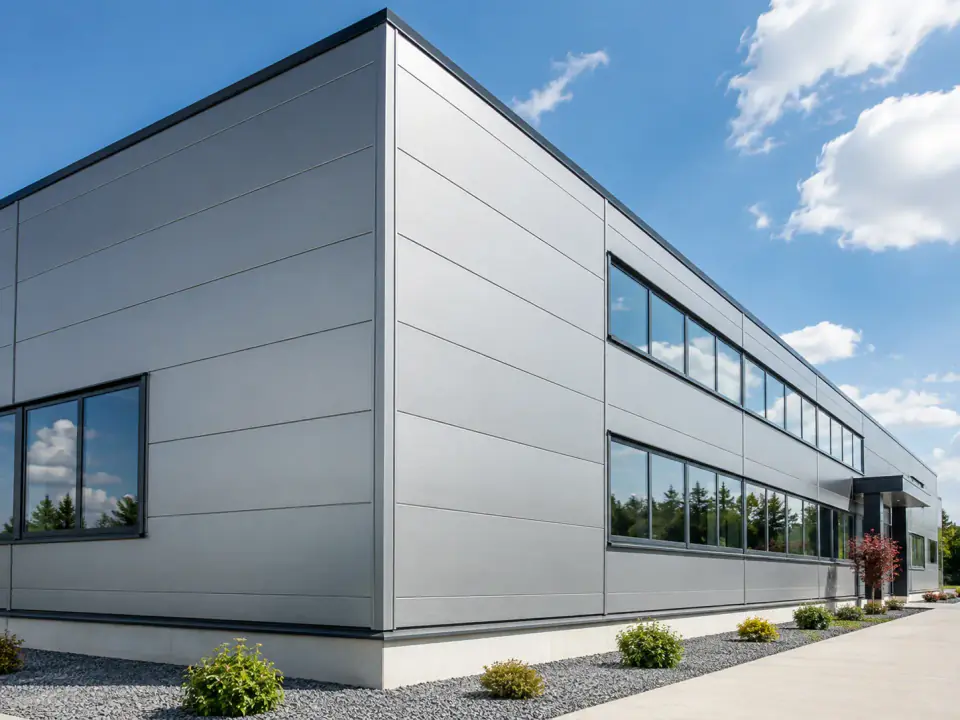
A sports floor is often part of a larger project, such as a new sports hall or a refurbished leisure building. If you are designing the building envelope as well, our guide to insulated sandwich panels covers a common wall solution for halls and large-span buildings, and our sandwich wall panels are designed for that kind of project. For changing rooms and washrooms, SPC wall panels offer a water-resistant interior finish. Our cladding specification checklist helps bring the decisions together.
To see the colours and surface texture in person, request samples of our PE floors, or talk to the team about your court, the base you have and the sports you want to play.
Frequently asked questions
What is PE sports flooring?
PE sports flooring is made from polyethylene, a tough, flexible plastic, usually formed into modular tiles that interlock to create a continuous playing surface. The tiles are laid loose over a prepared base rather than glued down. They are used for sports courts, multi-use games areas, school and leisure spaces and other high-traffic areas.
Can interlocking sports tiles be used outdoors?
Many interlocking tiles are designed for outdoor use, often with perforations so rain drains through to the base. The base itself must be firm, level and able to shed water. Check the specific product's guidance for outdoor use, UV exposure and temperature movement, and leave the perimeter expansion gaps the manufacturer specifies.
How do you clean interlocking sports floor tiles?
Regular sweeping or vacuuming removes grit that would otherwise wear the surface and reduce grip. For deeper cleaning, use water and a mild, non-oily detergent, then let the floor dry before play. Outdoors, clear leaves and debris so drainage stays open. Damaged tiles can usually be unclipped and replaced individually.