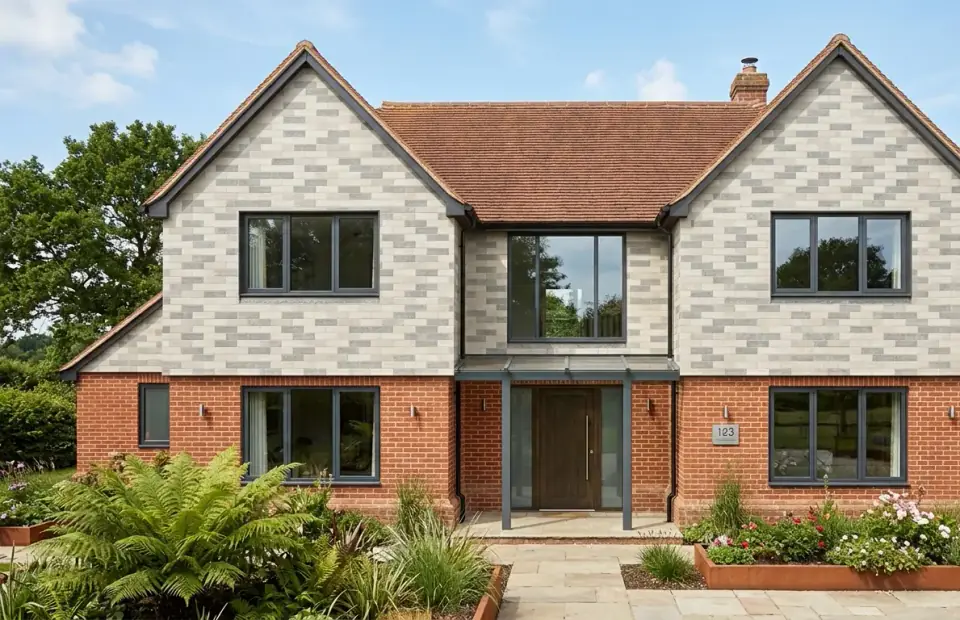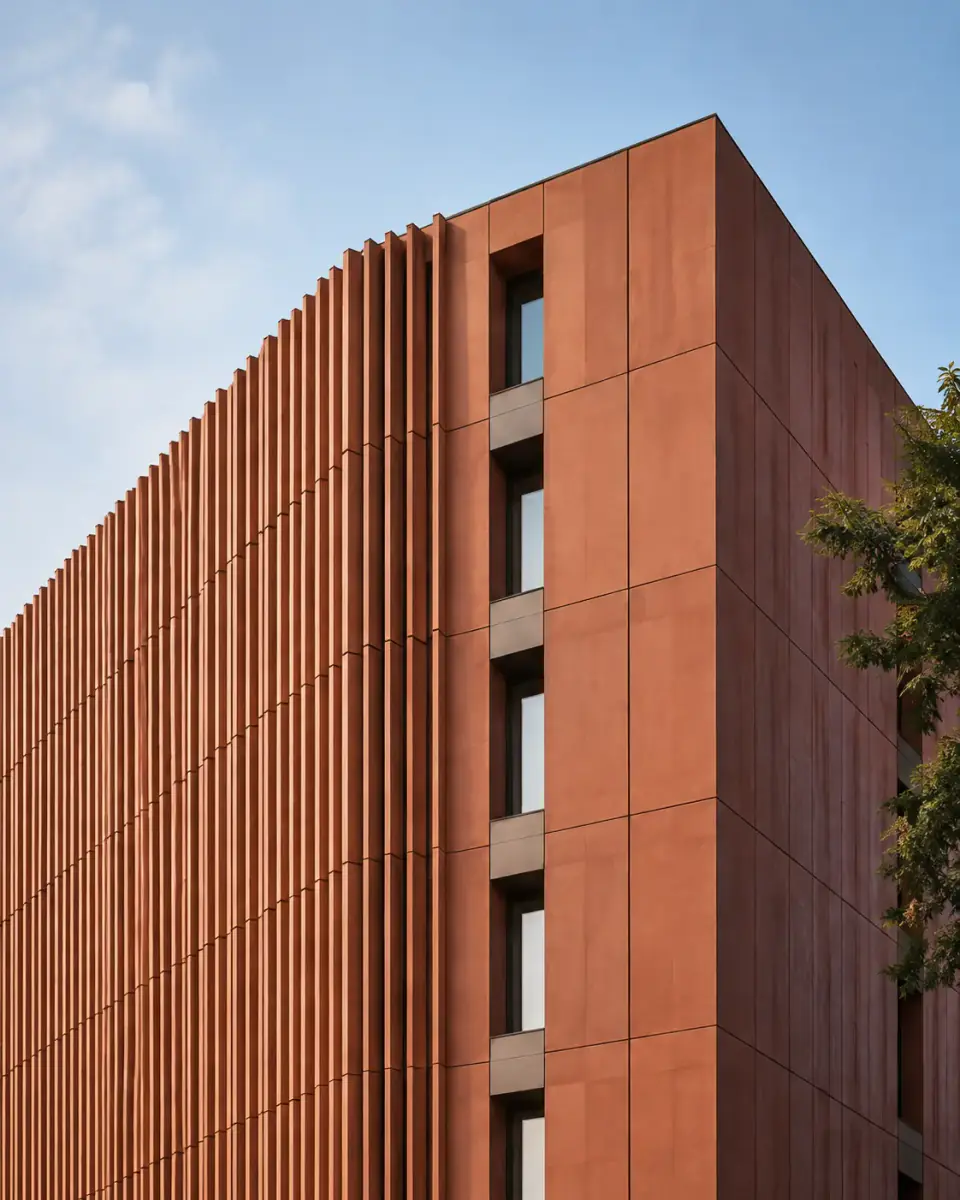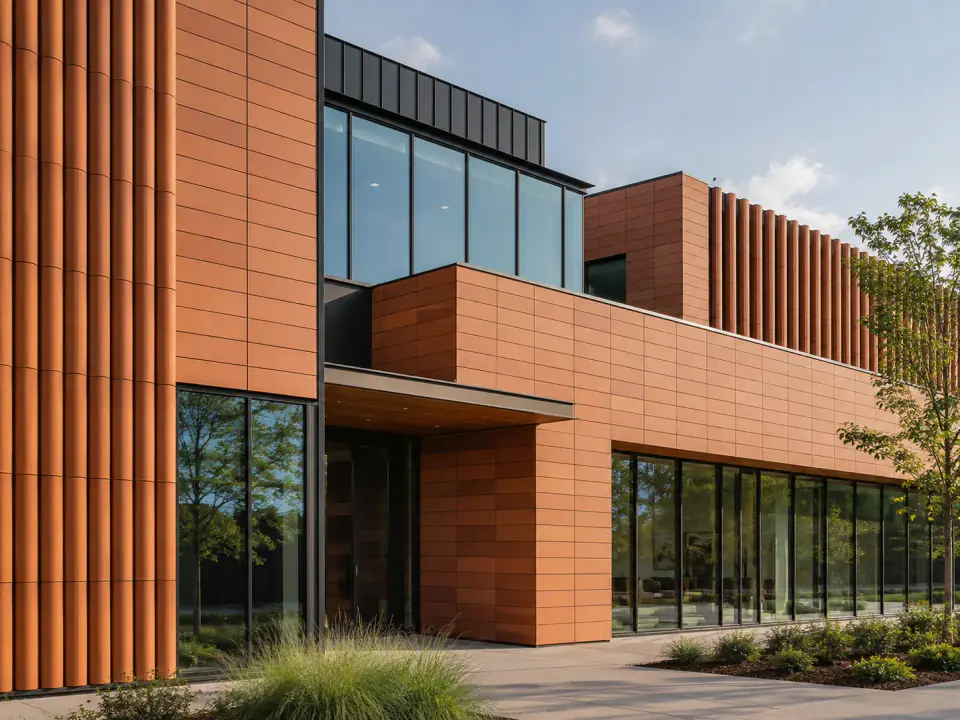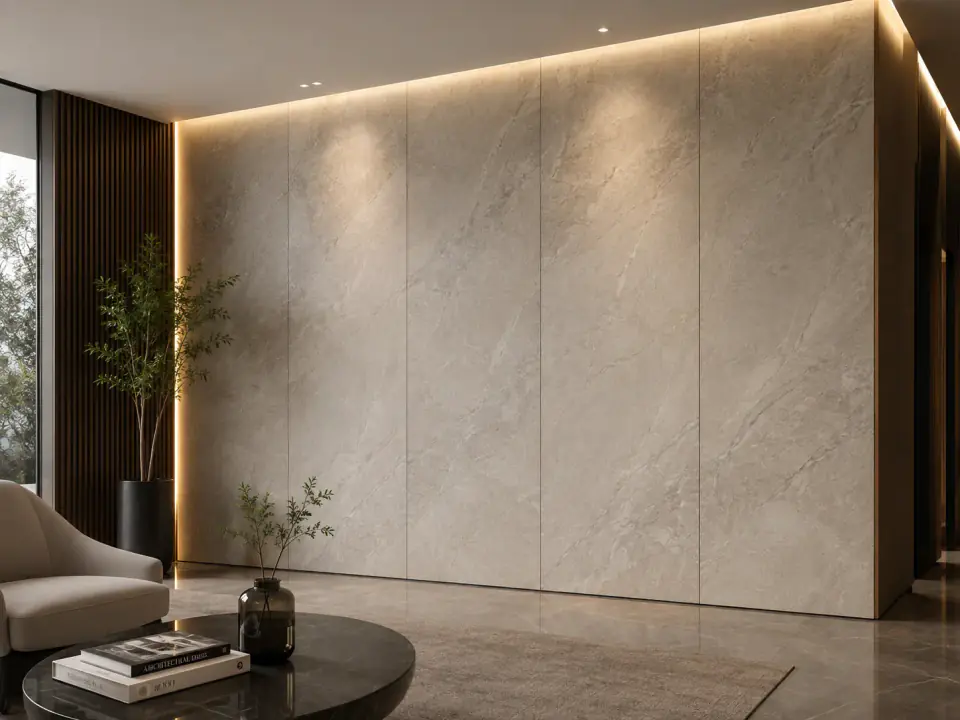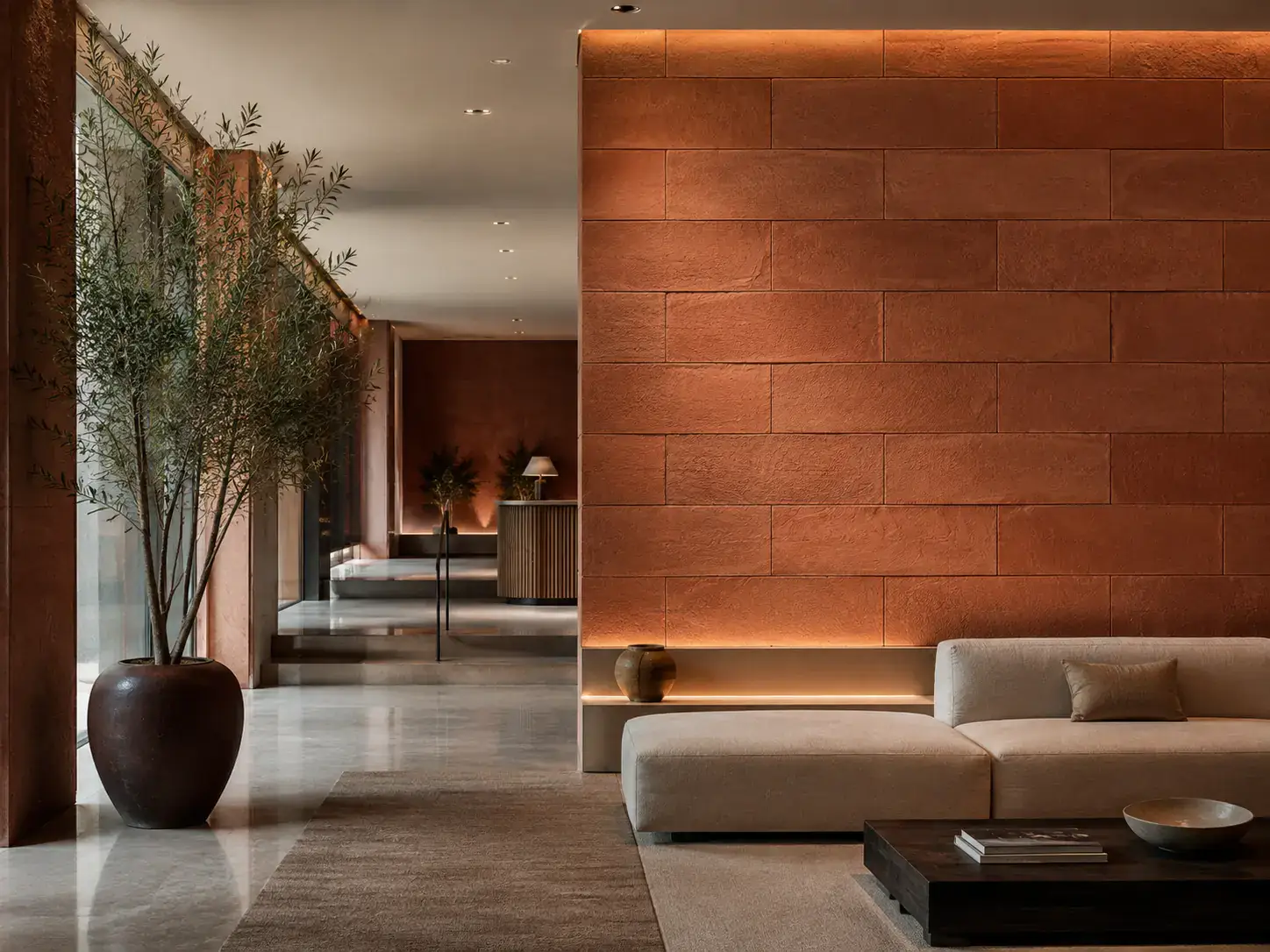
Modified clay material is a thin, lightweight cladding that reproduces the colour and texture of clay, brick, stone and other masonry finishes without their weight. Usually shortened to MCM, it is supplied as flexible tiles and sheets that can be bonded to flat walls and selected curved surfaces, indoors and on exterior façades. This guide explains what the material is, where it is used, how it compares with brick, stone and ceramic, and why the abbreviation needs care in UK fire-safety conversations.
What modified clay material is
MCM is a family of surface materials rather than a single recipe. In general terms, it starts with clay or other inorganic mineral powders that are modified with polymers, pressed or moulded into thin sections and cured, instead of being fired in a kiln like brick or ceramic tile. The modification is what gives the finished piece its flexibility and low weight.
Because the surface is moulded, it can carry a convincing texture: the grain of split stone, the face of a wire-cut brick, the drag lines of rammed earth or the soft unevenness of handmade clay. Colour runs through the body or sits in the surface layer, depending on the product.
Formulations vary between manufacturers. Treat any general description, including this one, as background, and use the manufacturer's data sheet as the definitive account of what a product is made of and how it performs.
Other names you will see
The same broad category is sold as soft stone cladding, flexible stone, flexible stone veneer, soft porcelain and MCM flexible tiles. The names overlap and are not standardised, so compare products on their data sheets and samples rather than their labels.
Where MCM cladding is used
Designers choose the material when they want the character of masonry but the wall, the programme or the geometry argues against the real thing. Typical uses include:
- Interior feature walls in living spaces, receptions, hotels, restaurants and retail, where texture is seen at close range.
- Exterior façades on houses, extensions and garden rooms, where a lighter finish avoids the foundations and support details a masonry skin would need.
- Refurbishment, where an existing wall needs a new face and adding significant load is not practical.
- Columns, curved walls and reveals, where rigid tiles would have to be cut into many small facets.
Billi's flexible tiles are made for these situations, with finishes such as Flex03, Flex05 and Flex21 covering a range of tones and textures.
Flat walls versus curved surfaces
On flat walls, MCM behaves much like any thin bonded finish. The substrate needs to be flat, sound, clean and dry, and the joint layout is set out before fixing starts so that cuts land in sensible places.
Curves are where the material earns its place. Because the tiles flex, they can follow a convex column or a concave wall without being cut into narrow strips. How tight a curve a product can follow depends on its thickness, format, texture and the conditions at installation, and some manufacturers recommend gentle warming to help the tile follow the form. Work to the manufacturer's stated limits rather than testing them on site.
The substrate has to carry the curve accurately. A flexible tile will faithfully follow a poor curve, so any flats or kinks in the backing will show in the finished wall. Our guide to flexible tiles for curved walls covers setting out, columns and edge details in more depth.
Interior versus exterior use
The same product family can often be used inside and out, but the specification changes.
Indoors, the main questions are substrate, adhesive and finish. Plaster, board and render backgrounds can all be suitable if they are prepared properly. Think about how light will cross the surface, because raking light from a window or a wall washer exaggerates texture and shows up uneven joints.
Outdoors, the wall has to manage water, temperature change and movement. Check the following before committing:
- The substrate is suitable for exterior bonding and is structurally sound.
- The adhesive and any primer are approved by the manufacturer for external use.
- Movement joints follow the building's existing joints and the manufacturer's spacing guidance.
- Copings, sills and window heads throw water clear of the face.
- The colour and texture fit the planning position. In England, permitted development usually allows a house to be clad only where the materials are of similar appearance to the existing house, and in designated areas such as Conservation Areas many cladding types need planning permission. Check with the local planning authority.
How MCM compares with brick, stone and ceramic
Each material has its place. The table compares them in general terms; individual products vary.
| Modified clay material | Brick or brick slip | Natural stone | Ceramic or porcelain tile | |
|---|---|---|---|---|
| Weight on the wall | Light | Heavy (full brick) to moderate (slip) | Heavy | Moderate |
| Follows curves | Selected curves, by flexing | By coursing or cutting | By cutting or shaping | Rarely, needs small formats |
| Cutting on site | Simple tools | Masonry saw | Masonry saw | Tile cutter or saw |
| Surface character | Moulded texture of clay, brick or stone | Real fired clay | Real stone, natural variation | Printed or glazed face |
| Main reason to choose | Masonry look with low weight and flexibility | Authentic brickwork | Authentic stone | Hard, easy-clean surface |
Where a project calls for real fired clay on a ventilated façade, a system such as Billi's terracotta claddings may be the better fit. Where weight, curves or speed of fixing lead the brief, MCM is usually the stronger candidate.
MCM and fire safety: the naming confusion
This point matters for anyone reading UK fire-safety documents. In regulations and guidance, "MCM" almost always means metal composite material: aluminium-faced panels with a core between the sheets. Modified clay material is a different product that happens to share the initials.
The distinction is important because of the rules on external walls in England. Regulation 7(2) of the Building Regulations 2010 requires materials in the external walls and specified attachments of relevant buildings with a storey over 18 metres to achieve European classification A1 or A2-s1,d0, subject to listed exemptions. Relevant buildings include flats, hospitals, care homes, student accommodation and dormitories, and a 2022 amendment added hotels, hostels and boarding houses. The same amendment banned metal composite material panels with an unmodified polyethylene core on buildings of any height.
That ban concerns aluminium composite panels, not modified clay. It does not follow that modified clay material is automatically acceptable either. For any building, check the specific product's classification report against the project, and confirm the route with a fire engineer and building control. For residential buildings with a storey between 11 and 18 metres, Approved Document B also gives guidance, and it has been under review, so work from the current edition. Our article on cladding fire safety in the UK sets out the wider picture.
Specifying MCM: a short process
- Define the use. Interior or exterior, flat or curved, and the building type and height.
- Check the rules. Confirm the planning, Building Regulations and fire classification position for this building.
- Assess the substrate. Confirm it is sound, flat or accurately curved, and compatible with the recommended adhesive.
- Shortlist finishes on samples. View them in daylight and under the project's artificial lighting.
- Build a mock-up. A small panel shows joint width, colour variation and how the texture reads at distance.
- Follow the installation guidance. Adhesive, joints, movement joints and curing conditions as the manufacturer specifies.
See the material in person
Texture and colour are hard to judge from a screen, so the best next step is to handle the material. Request samples of the flexible tile finishes, or speak to the team about your substrate, location and design intent, and we can help you narrow the choice.
Frequently asked questions
Is MCM cladding the same as metal composite material?
No. In UK fire-safety documents MCM usually means metal composite material, which is aluminium-faced panelling with a core between the sheets. Modified clay material is a different, mineral-based surface that shares the initials. The 2022 ban on metal composite panels with an unmodified polyethylene core does not describe modified clay, but you should still check the specific product's classification report.
Can modified clay material be used on exterior walls?
Many modified clay products are designed for exterior façades as well as interiors. Outside, the specification needs an exterior-rated adhesive, a sound substrate, movement joints and good water-shedding details. Check planning rules, Building Regulations and the product's classification report for the building, and follow the manufacturer's installation guidance closely.
What is the difference between soft stone and MCM?
In most cases there is no real difference. Soft stone, flexible stone veneer and MCM flexible tiles are overlapping trade names for thin, flexible, mineral-based surfaces. Because the names are not standardised, compare products using their data sheets, samples and installation guidance rather than relying on what they are called.