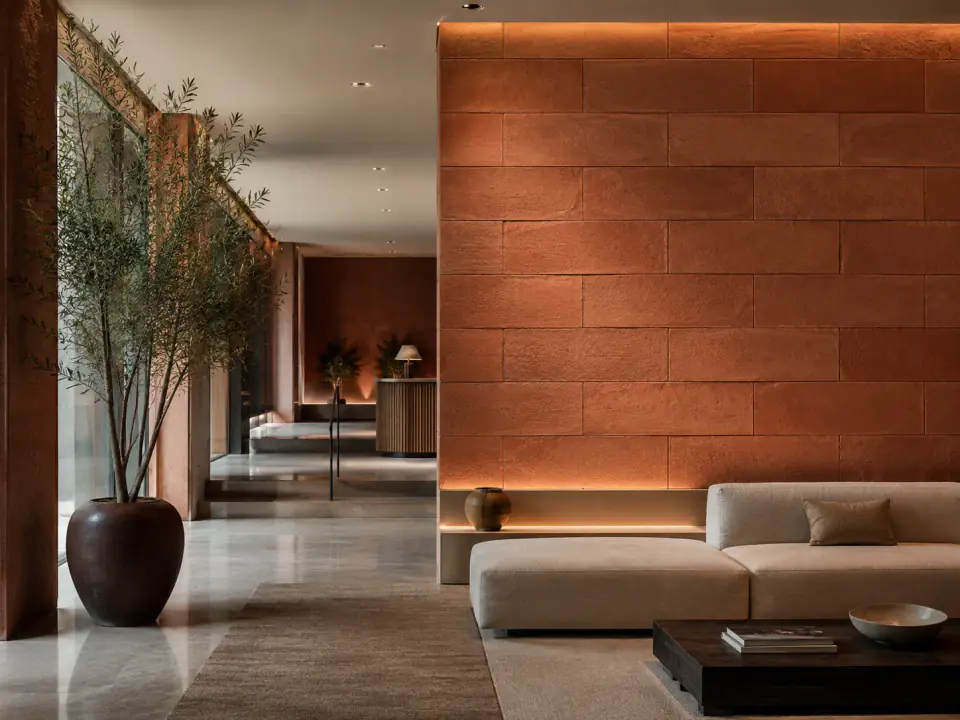
SPC wall panels are rigid decorative boards made from stone plastic composite, a mix of mineral powder and PVC, finished with a printed stone, marble or wood design. They are water-resistant, quick to fit and easy to wipe clean, which makes them a popular choice for feature walls, bathrooms, kitchens and commercial interiors. This guide explains what SPC is, where it works, what "waterproof" really means in practice and how to install the panels well.
What SPC (stone plastic composite) is
In general terms, the core of an SPC panel is mostly powdered limestone, or calcium carbonate, bound with PVC and stabilisers. The mix is extruded into a dense, rigid board. A decorative film printed with a stone, marble or wood design is laminated to the face, usually protected by a clear surface layer.
The mineral content is what gives SPC its stiffness and weight, and it helps the board stay flat and stable compared with many lighter all-plastic panels. The "stone" in the name refers to that mineral content. The surface is a printed image, not real stone, which is why the quality of the print and the surface layer make such a difference to how convincing a panel looks.
Formulations vary between manufacturers. Use the data sheet for the definitive description of a specific product and its performance.
Where SPC wall panels work
SPC panels are designed for interiors. Typical uses include:
- Living room and bedroom feature walls, where a stone or marble effect becomes the focal point of the room.
- Bathrooms and cloakrooms, as bathroom wall panels that replace or cover tiling.
- Kitchens and utility rooms, subject to the manufacturer's guidance on clearances from hobs and other heat sources.
- Offices and receptions, where a hard-wearing surface needs to look premium.
- Hotels, restaurants and retail, where walls need refreshing without long closures.
Billi's SPC wall panels are water-resistant decorative interior panels with stone or wood finishes, including SPC011, GSPC-013 and GSPC-023, for homes, offices, hotels, restaurants and retail.
Choosing a stone or wood effect
Stone and marble effects suit large, uninterrupted walls where the veining can run across several panels, such as behind a sofa, a bed or a reception desk. Wood effects bring warmth to bedrooms, offices and hospitality spaces, and they read best when the grain direction is consistent across the wall.
Check two things on any printed finish. First, how often the pattern repeats: on a wide wall, an obvious repeat can give the effect away, so ask how many print variations the range includes. Second, how the surface handles light. Gloss and polished-marble finishes reflect windows and downlights strongly and show any unevenness in the wall behind, while matt and textured finishes are more forgiving. Viewing samples under the room's actual lighting avoids surprises.
What "waterproof wall panels" really means
SPC panels are often sold as waterproof wall panels. The board itself is water-resistant: it does not absorb water, swell or soften the way plasterboard, MDF or some timber-based boards can. That is a real advantage in bathrooms and kitchens.
A wall is more than its boards, though. Water gets behind panels through joints, unsealed edges, corners and the holes cut for taps, valves and pipes. In a shower or around a bath, the panel system, its trims and its sealants decide whether the wall stays dry. Check whether the manufacturer approves the panel for direct shower areas and follow its sealing details exactly.
Water resistance does not remove the need for ventilation either. Condensation still forms on cold surfaces, and an extractor fan remains important for controlling moisture and mould in the room.
SPC compared with other wall finishes
| SPC wall panels | Ceramic tiles | Painted plaster | WPC panels | Natural stone cladding | |
|---|---|---|---|---|---|
| Water resistance | Board resists water; joints need sealing | Tile resists water; grout and sealing matter | Limited | Varies by product | Varies by stone and sealing |
| Installation | Relatively quick, dry trades | Slower, wet trades | Plastering and decorating | Battens, clips or adhesive | Specialist, heavier |
| Surface | Printed stone or wood | Glazed or printed | Paint | Wood-look, often profiled | Real stone |
| Joints | Few, large panels | Many grout lines | None | Profile joints | Visible joints |
| Indoor or outdoor | Interior | Both, by product | Interior | Both, by product | Both, by product |
If you want a warmer, slatted wood look, or a panel that can also be used outdoors, Billi's WPC panels are the natural comparison. Our guide to SPC vs WPC wall panels sets out the differences in detail.
How to install SPC wall panels
Installation methods vary by system, so the manufacturer's instructions always come first. A typical sequence looks like this:
- Acclimatise the panels in the room for the period the manufacturer recommends, so they reach room conditions before cutting.
- Check the substrate. It should be sound, dry, clean and flat. Fill hollows and remove loose material or loose tiles.
- Set out the layout. Plan where joints fall, centre the pattern on the wall and match stone veining across panels.
- Cut accurately. Use the cutting method the manufacturer recommends and cut openings for sockets and pipes before fixing.
- Fix with the specified method. Use the recommended adhesive, clips or battens, with the coverage specified.
- Leave movement gaps at edges, corners and junctions where the system calls for them, hidden by trims.
- Seal and trim. Apply the recommended sealant at edges, corners and penetrations, especially in wet areas.
- Clean the face of adhesive and marks before it cures.
The most common mistakes are fixing to an uneven wall, skipping acclimatisation and leaving edges unsealed in wet areas.
Fire and specification points
Wall linings inside buildings also have fire performance guidance under Approved Document B, and what applies depends on the room, the building type and its use. Approved Document B has been under review, so work from the current edition. Before specifying, particularly in commercial, hospitality or multi-occupancy buildings, check the specific product's classification report and confirm its suitability with building control.
Other points to check include impact resistance in busy corridors, clearances from heat sources, the effect of strong direct sunlight on printed surfaces and the cleaning products allowed.
Care and maintenance
SPC panels are easy to look after. Wipe them with a soft cloth and a mild detergent solution, then dry the surface. Avoid abrasive pads, scouring powders and strong solvents unless the manufacturer approves them, because they can dull or scratch the surface layer.
In bathrooms, inspect sealant lines periodically and renew any that have split or discoloured. Our guide on how to clean and maintain cladding covers care for other surface types.
Choose your finish with samples
Printed stone and wood finishes vary a lot between products, and they are best judged under the room's own lighting. Request samples of the SPC finishes, or talk to the team about your walls, wet areas and installation approach.
Frequently asked questions
Are SPC wall panels waterproof?
The board itself is water-resistant: it does not absorb water or soften the way plasterboard or MDF can. Whether a wall stays dry depends on the installation, especially joints, edges, corners and penetrations around taps and pipes. In wet areas, follow the manufacturer's system for sealants and trims, and make sure the room is well ventilated.
Can SPC wall panels be used in a bathroom?
Yes, bathrooms are one of the most common uses, because the panels resist water and wipe clean without grout lines. Check whether the manufacturer approves the panel for direct shower areas, use the recommended adhesive, sealants and trims, and seal around fittings carefully. Good ventilation is still needed to control condensation.
Can you put SPC panels over existing tiles?
Often it is possible, if the existing tiles are firmly bonded, flat, clean and compatible with the recommended adhesive or fixing method. Loose or hollow tiles should be removed first. Check the manufacturer's guidance on substrates, since some systems need priming or a different fixing approach over glazed surfaces.